
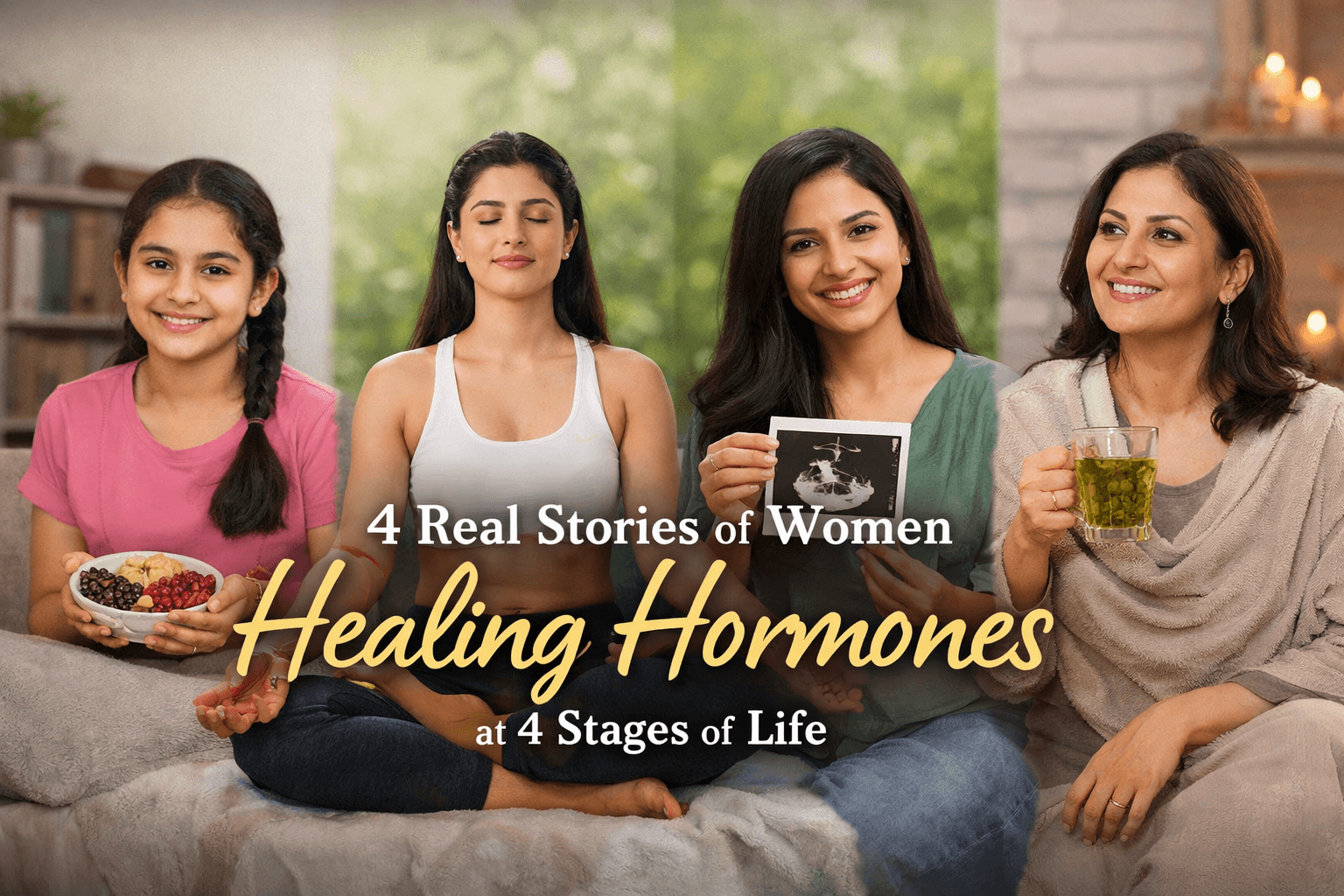
Discover how four women across puberty, PCOD, infertility and menopause, found natural healing through hormonal balance. At Santushti Holistic Health, we support every stage of a woman’s journey with mindful nutrition, lifestyle care, and root-cause healing.
Women across different stages of life face challenges that may seem unrelated on the surface, painful periods during puberty, PCOD in young adulthood, infertility in the 30s, and heavy bleeding or emotional turbulence during menopause.
But at Santushti Holistic Health, we’ve noticed a powerful truth across thousands of consultations: many of these concerns trace back to the same root, hormonal imbalance.
These issues are becoming increasingly common.
India is witnessing a sharp rise in PCOD and PCOS, affecting nearly 1 in 5 young women.
Sleep disorders and stress are now leading contributors to infertility.
And close to 70% of menopausal women report symptoms that deeply affect their quality of life.
Yet, despite these numbers, one thing remains constant: every woman’s body has an extraordinary capacity to heal when supported with nourishment, rest, mindful routines, and emotional balance.
This is where Santushti Holistic Health steps in, by guiding women back to their body’s natural rhythm.
Below are four real-life journeys that remind us how beautifully the body responds when we nourish it, support it, and trust it.
Case 1. Aadya, 13: Painful Periods & Puberty Nutrition
Aadya’s mother came to us seeking guidance on what to include in her daughter’s diet during puberty to improve her nutritional balance. Her biggest question was,
“What should I add to my daughter’s diet so her periods become pain-free?”
Puberty is a time of rapid hormonal shifts, and micronutrients, especially iron and calcium play a crucial role in supporting menstrual health.
Iron supports oxygen flow and energy, while calcium helps regulate muscle contractions, reducing cramps.
Root Issue Identified
Micronutrient deficiencies, particularly iron and calcium are essential for teenage hormonal stability.
Studies show that up to 40% of Indian teenage girls are iron-deficient, one of the biggest contributors to painful periods, mood swings, and fatigue.
What we focused on:
We added natural, bioavailable sources of iron and calcium through:
- Pomegranate (Anaar)
- Black sesame seeds (Kaale til)
- Black raisins (Kale kishmish)
- Figs (Anjeer) & dates (Khajoor)
- Spinach (palak)
- Moringa (Sahjan patta / Drumstick leaves)
Result
Within just three cycles, Aadya experienced completely pain-free periods, a powerful sign that her body was absorbing and responding to the right nutrition.
A true mother-daughter victory.
A gentle reminder that early hormone care begins in the kitchen.
Also read: https://santushtibylavleen.com/blog/how-can-diet-and-lifestyle-help-in-ensuring-menstrual-health
Case 2. Japjeet, 20: PCOD
Japjeet was highly active in sports and gym activities, yet she was diagnosed with PCOD. She was advised to take oral contraceptive pills( birth control pills) to regulate her periods, but she wanted to avoid medication and heal naturally.
Root Issue Identified
Her body was active, but her mind was overactive.
Overthinking, mental restlessness, and screen-induced stress had triggered a hormonal imbalance.
What we focused on:
Mind-body slowing
Teaching the body to pause, breathe, and regulate cortisol.
Yoga for hormonal alignment:
- Cobra pose (Bhujangasana)
- Setu Bandhasana (Bridge pose)
- Malasana (Garland pose)
These poses support pelvic circulation and balance reproductive hormones.
Reducing late-night screen time
Blue light disrupts melatonin, which disrupts hormones.
Sleep couldn’t improve until screens were reduced.
Prioritising deep, restorative sleep
Because restful sleep is the first medicine for PCOD.
Why this mattered
Hormones don’t heal under pressure.
Her body didn’t need more intensity.
It needed balance, softness, and stillness.
Result
As her mind slowed down, her hormones followed.
Her cycle began regulating naturally, no pills required.
3. Ruchi, 32: Infertility
Ruchi had been trying to conceive for years and wanted to conceive naturally.
Doctors suggested IVF, but she wanted to try a natural route first.
Root Issue Identified
Persistent sleep disturbance due to overthinking was disrupting melatonin production and, in turn, affecting her reproductive hormones.
Melatonin is closely connected to the hormones that regulate ovulation and fertility. When sleep is irregular, the body cannot maintain hormonal balance.
What we focused on:
Mind Coaching
To calm the mind before bed and reduce nighttime overthinking.
Magnesium-rich foods
Such as pumpkin seeds, almonds, spinach, and sesame seeds to support deeper, uninterrupted sleep and ease nighttime anxiety.
Night-time sleep hygiene
We helped her build a structured wind-down routine, including:
- Keeping a fixed sleep and wake time
- Reducing screen exposure at least one hour before bed
- Dim lighting in the evening to support melatonin release
- A calming pre-sleep ritual, such as reading, warm water, or gentle stretching
- Avoiding stimulating conversations or work in late hours
- Creating a quiet, cool, sleep-friendly environment
Good sleep hygiene helps switch the body from stress mode to healing mode, allowing reproductive hormones to regulate naturally.
Gentle movement
Engage in light activity during the day to support hormonal balance without adding stress.
Nourishing meals
Balanced meals to stabilise blood sugar, as fluctuations also affect sleep and reproductive hormones.
Result
As her sleep improved, her hormonal rhythm stabilised.
Ruchi conceived, and last Diwali, she shared pictures of her healthy baby boy with us that was like a gift to us.
Her case reminded us that sometimes the first step toward fertility lies in restoring sleep and calming the mind, not increasing treatments.
4. Meenakshi, 45: Menopause
As Meenakshi approached menopause, she struggled with severe, prolonged bleeding.
Doctors recommended a hysterectomy, but she wished to explore natural healing first.
Root Issue Identified
Perimenopausal hormonal fluctuations, intensified by lifestyle and dietary patterns.
What helped:
- Coriander seeds water (Dhaniya)
- Variali / fennel water (Saunf)
- Hormone-supportive dietary changes
- Gentle lifestyle adjustments
Result
Her bleeding has reduced, symptoms have eased. As of now, a hysterectomy may not be necessary. She is still actively following our guidelines, and we remain hopeful that surgery can be avoided altogether.
Her case is a reminder that menopause is a transition, not a disease, and with the right support, the body can often regulate itself. The body knows how to heal when given the right environment.
Four women. Four stages of life. Only one common solution – balancing hormones naturally.
In every home, the health of one woman silently shapes the health of everyone around her.
And this is why her well-being is not a luxury, it is the foundation of a healthy family.
At Santushti Holistic Health, we’ve seen this truth repeat itself over and over:
When a woman heals, a family transforms.
When a family transforms, a generation heals.
Santushti isn’t just a wellness approach, it’s a mindset.
It’s not magic. It’s understanding your body and working with it, not against it.
We believe in:
- Honouring the body’s natural intelligence
- Root-cause healing instead of symptom-chasing
- Mindfulness, gratitude, and emotional awareness
- Simple, sustainable lifestyle shifts
- Food as nourishment, not fear
Healing begins when we pause, breathe, and reconnect with our inner wisdom.
This is Santushti.
It’s all about belief and trust in your body, that Nature has Healing Power.
Ek aas rakho maan maahe,
Nanak sab rog mitt jaye.
All problems can be resolved when we understand the root.