
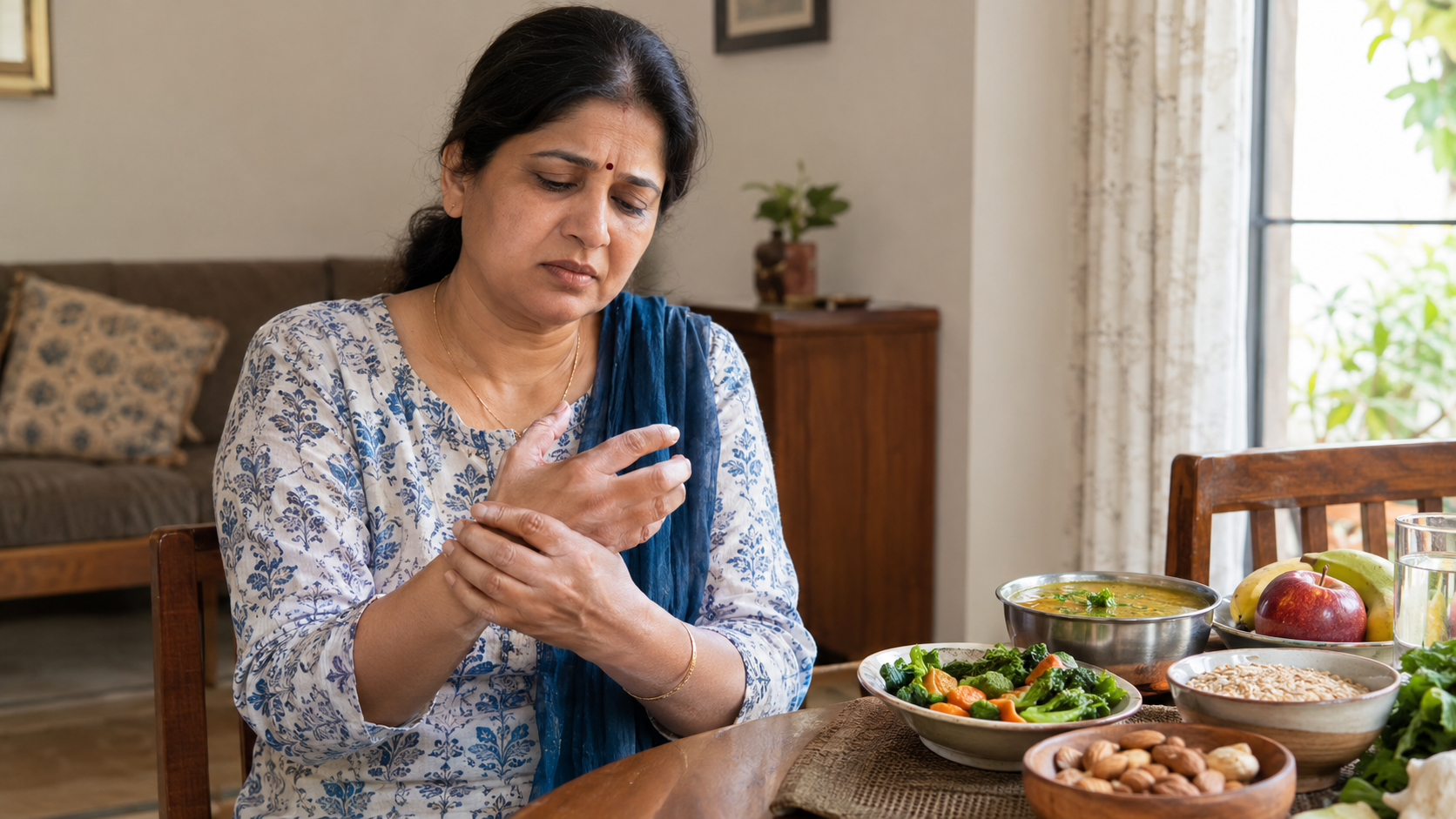
A 45-year-old woman diagnosed with rheumatoid arthritis consulted Santushti Holistic Health with a simple question: “Tell me what diet I should follow so my pain reduces.” And the answer to her question wasn’t simple. Here’s what we advised her to do and eat:
Blood Reports
Her reports clearly pointed toward three key concerns:
Inflammation markers – Elevated
- ESR (Erythrocyte Sedimentation Rate)
- CRP (C-Reactive Protein)
- Homocysteine
Autoimmune marker – Positive
- ANA (Antinuclear Antibody)
Nutrient deficiencies – Low
- Vitamin B12
- Vitamin D
These findings together indicated chronic inflammation, immune system activation, and underlying nutritional deficiencies. It is a combination commonly seen in autoimmune conditions like rheumatoid arthritis.
Medical & Lifestyle History
Her history revealed several long-standing factors that contributed to her condition:
- Gallbladder removal surgery 10 years ago
- Sedentary desk job (banking profession)
- Minimal physical activity for several years
- Prolonged mental stress
- Lack of structured dietary and lifestyle management
- Long-standing chronic acidity
- Regular antacid use for nearly 10 years
Taken together, these factors gradually weakened her gut health, impaired nutrient absorption, and placed continuous stress on her immune system, eventually contributing to autoimmune inflammation.
What Went Wrong? The Lessons We Learned
1. Long-term antacids damaged her gut and immunity
Antacids are commonly used to relieve acidity, but few people understand what they actually do. They neutralise stomach acid (HCL), making the stomach environment alkaline.
What’s often missed is that the gut needs adequate HCL to function properly. Stomach acid is essential to:
- Kill harmful bacteria and pathogens
- Prevent infections
- Enable proper digestion
- Regulate immune function
- Support the absorption of minerals like calcium, magnesium, and iron
When antacids are taken occasionally, the body may cope. But when they are used daily for years, the consequences begin to accumulate, says Lavleen Kaur, the best dietitian in India.
With long-term antacid use:
- Harmful bacteria are no longer effectively eliminated
- Gut bacteria balance is disturbed
- Nutrient absorption weakens
- The immune system becomes dysregulated
- Calcium begins to leach from the bones Chronic inflammation builds
Over time, this immune confusion leads the body to mistakenly attack its own tissues, particularly the joints.
In her case, the pattern was clear:
Chronic acidity → long-term antacid use → weakened gut health → calcium depletion → immune system dysregulation → rheumatoid arthritis after 10 years
What began as a small, ignored acidity issue eventually manifested as a life-altering autoimmune condition.
This case reminds us that suppressing symptoms without addressing the root cause can silently pave the way for chronic disease.
2. Vitamin D was not working because magnesium was missing
She had been taking Vitamin D intermittently, believing calcium and other nutrients were unnecessary because of joint pain.
But in her case, Vitamin D absorption was incomplete without magnesium.
Magnesium is essential for:
- activating Vitamin D
- calming inflammation
- supporting nerve and muscle function
Without it, immunity weakens further.
3. Post-gallbladder removal requires daily movement
Once the gallbladder is removed, the body loses its natural bile storage system. This means digestion, liver function, and immune balance become highly dependent on daily lifestyle habits.
In such cases, a sedentary lifestyle is not an option, says Lavleen, the best dietitian in Chandigarh. To keep the liver active and support digestion, the following are mandatory, not optional:
- At least 5 minutes of movement after every meal to aid bile flow and digestion
- 30–40 minutes of active movement daily to support liver function and metabolic balance
These practices cannot be skipped or postponed. They are as essential as medication. You cannot afford to miss them like a pill.
In her case, years of physical inactivity after gallbladder removal placed continuous stress on digestion, weakened immune regulation, and contributed to systemic inflammation.
4. Autoimmune diseases can be managed, not cured
Autoimmune conditions like RA:
- cannot be fully reversed
- cannot be permanently cured
- but can be managed effectively with the right approach.
Flare-ups are often triggered by a combination of factors, including:
- Environmental and chemical toxins
- Gut imbalance and digestive stress
- Ongoing mental toxicity
- Emotional stress
- Nutrient deficiencies
- Lifestyle disruptions and irregular routines
How We Helped Ease Her Pain
Our approach was to address the root causes behind her inflammation, not just the pain. We worked on four areas.
1. Rebuilding gut health
Reviewed antacid use
Our team, which includes the best dietitian in India, worked with her, in consultation with her doctor, on a gradual plan to reduce dependence on daily antacids. She was not asked to stop them abruptly.
Supported natural digestion
She followed a simple, easy-to-digest diet with regular meal timings, mindful eating, and proper chewing.
Restored gut balance
We added gut-friendly, anti-inflammatory foods such as fermented foods, fibre-rich vegetables, and home-cooked meals, and reduced processed and inflammatory foods.
2. Correcting nutrient deficiencies
Vitamin D with magnesium
Since magnesium is needed to activate Vitamin D, we paired the two and encouraged magnesium-rich foods. Vitamin D was taken consistently, not intermittently.
Vitamin B12
We addressed her low B12 through diet and supplementation as advised by her doctor.
Calcium and mineral support
We reintroduced calcium-rich foods to protect her bones. Joint pain does not mean calcium should be avoided.
3. Calming inflammation
Anti-inflammatory diet
We emphasised fresh vegetables, healthy fats, and whole foods, with turmeric, ginger, and omega-3 sources included where suitable.
Reducing triggers
We cut down on foods and habits that add to digestive stress, irregular routines, and toxin exposure.
Tracking progress
We monitored her inflammation markers (ESR, CRP, and homocysteine) to see how she was responding.
4. Lifestyle changes for a post-gallbladder body
Movement after meals
She took at least 5 minutes of light walking after every meal to support bile flow and digestion.
Daily activity
She built up to 30–40 minutes of active movement each day, treated as non-negotiable, like a daily pill.
Stress management
She practised simple stress-relief habits such as breathing exercises, adequate sleep, and a regular routine, since her stress had been prolonged.
The Result
Within a few weeks, her digestion, energy levels, and pain began to improve. The most important shift was in her understanding: she saw that her condition is not cured but can be managed, and that daily habits play a major role in keeping flare-ups away.
At Santushti Holistic Health, our focus is not on suppressing the immune system, but on supporting balance. Because the immune system is not in our control. The goal is to reduce the intensity and frequency of flare-ups, so individuals can maintain mobility, energy, and a good quality of life.
Disclaimer: This guidance is based on the clinical experience of the best dietitian in Chandigarh and time-tested client outcomes. It is not a substitute for professional medical advice. Please consult a qualified healthcare provider before making any major changes to your diet or lifestyle.